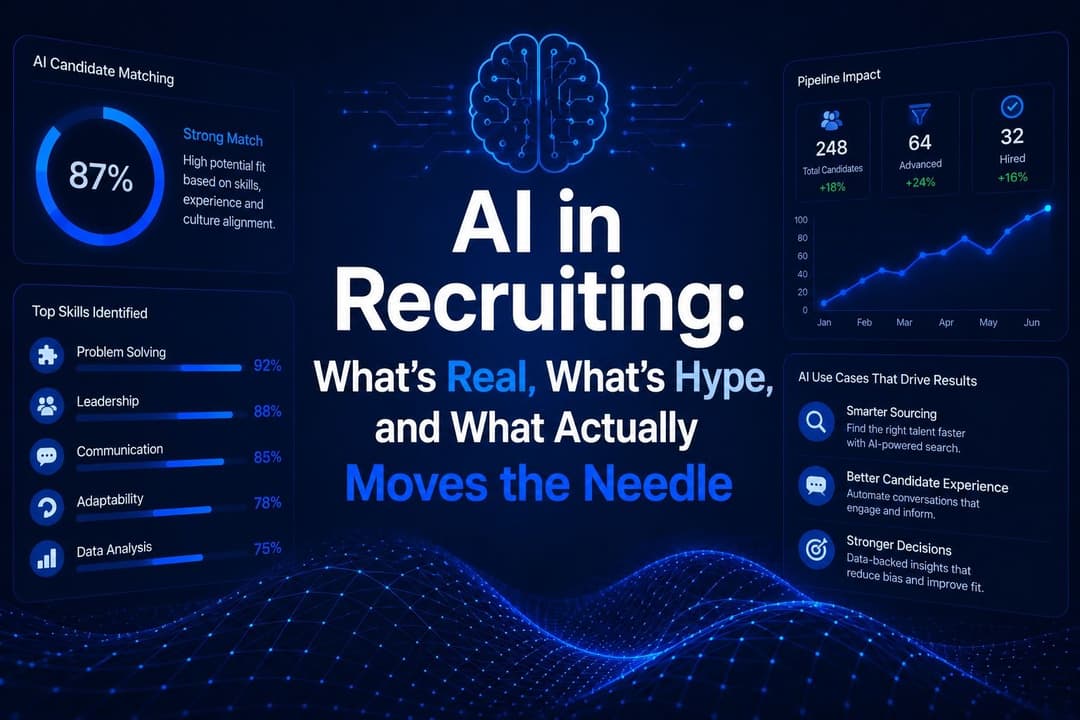
The AI hype cycle in HR tech is in full swing. When I walk through any HR conference, open any recruiting trade publication, or visit any ATS vendor’s homepage and I find “AI-powered” plastered across everything.
Most of it doesn’t hold up to scrutiny.
It’s not because AI can’t transform recruiting, It’s because most vendors are applying AI to surface-level features while leaving the underlying architecture completely unchanged. The result is a polished demo that doesn’t deliver meaningful outcomes.
Here’s a framework for telling the difference.
❌ AI Hype: Features That Sound Impressive But Don’t Move the Needle
Resume summarization. Yes, using an LLM to generate a 3-sentence summary of a resume is faster than reading the resume. But it doesn’t improve match quality, reduce time-to-fill, or change who gets hired. It’s a time-saver dressed up as a capability.
“AI-powered” job description writers. Generating a job description template with AI is marginally useful, it doesn’t improve the quality of your pipeline, it doesn’t source better candidates, It doesn’t learn from your hiring history.
Chatbots on career pages. FAQs and pre-screening questions handled by a chatbot reduce some admin burden, they don’t fundamentally change how you find and evaluate talent.
Resume keyword ranking. If the AI is still using keyword matching as its primary signal for candidate quality, it’s just a faster version of a 1990s algorithm. It doesn’t understand context, trajectory, or fit.
These features are not useless. But they’re not the transformation vendors claim they are.
✅ AI That Actually Matters: What to Look For
Proactive, outbound sourcing at scale. AI that can identify high-fit candidates from a massive global database—including passive candidates who aren’t actively applying—and run personalized outreach sequences autonomously. This expands your reachable talent pool from “people who applied” to “best available candidates.”
Continuous learning from outcomes. AI that improves based on what actually happened: who advanced through interviews, who got hired, who succeeded in the role. Systems that use outcome data to refine future recommendations are fundamentally different from systems that only process input data.
Unified data models. AI is only as good as the data it operates on. If your AI sits on top of disconnected silos, it’s working with incomplete information. AI built into a fully integrated platform—where sourcing, interview, assessment, and offer data all live together—can surface patterns that siloed AI simply can’t see.
Autonomous workflow execution. AI that doesn’t just recommend but acts: scheduling interviews, generating outreach sequences, summarizing interview feedback, populating scorecards. The difference between AI as an advisor and AI as an operator matters enormously for actual efficiency.
🔍 The Question to Ask Every Vendor
When an ATS vendor tells you about their AI capabilities, ask them one question:
“What data does your AI learn from, and how does that learning change future recommendations?”
If they can’t give you a clear answer about the feedback loop—what outcomes the AI observes, how those observations update the model, and how that improves future sourcing and matching—then the AI is input-only. It reads data but doesn’t learn from results.
Input-only AI can process faster, it can’t get smarter.
🔁 How SCALIS Approaches AI
We built SCALIS’s AI architecture around one core principle: every hire should make the next hire better.
That means Bella, our sourcing agent, doesn’t just work from job description keywords. She learns from your company’s specific hiring history: what profiles progressed through your interviews, what assessment scores correlated with successful hires, what feedback from your team predicts long-term performance.
Over time, Bella’s recommendations become more precise for your organization—not generic patterns from an aggregate model, but intelligence specific to your hiring context.
And because SCALIS is a fully integrated platform, the data Bella learns from is complete: sourcing signals, application behavior, interview performance, offer outcomes, and post-hire indicators all feed a single model.
That’s what AI-native recruiting actually looks like, not a summary feature. An engine that gets smarter.
🧭 The Practical Takeaway
When evaluating recruiting AI, ignore the demos that show you features, ask to understand the architecture. How does data flow? What outcomes does the system observe? How does it improve?
If the answer is vague, the AI is probably surface-level. If the vendor can walk you through a clear learning loop with specific examples of how outcomes improve over time, you’re talking to someone who’s built something real.
Curious what real AI-native recruiting looks like in practice?
👉 Book a SCALIS demo and ask us the hard questions.