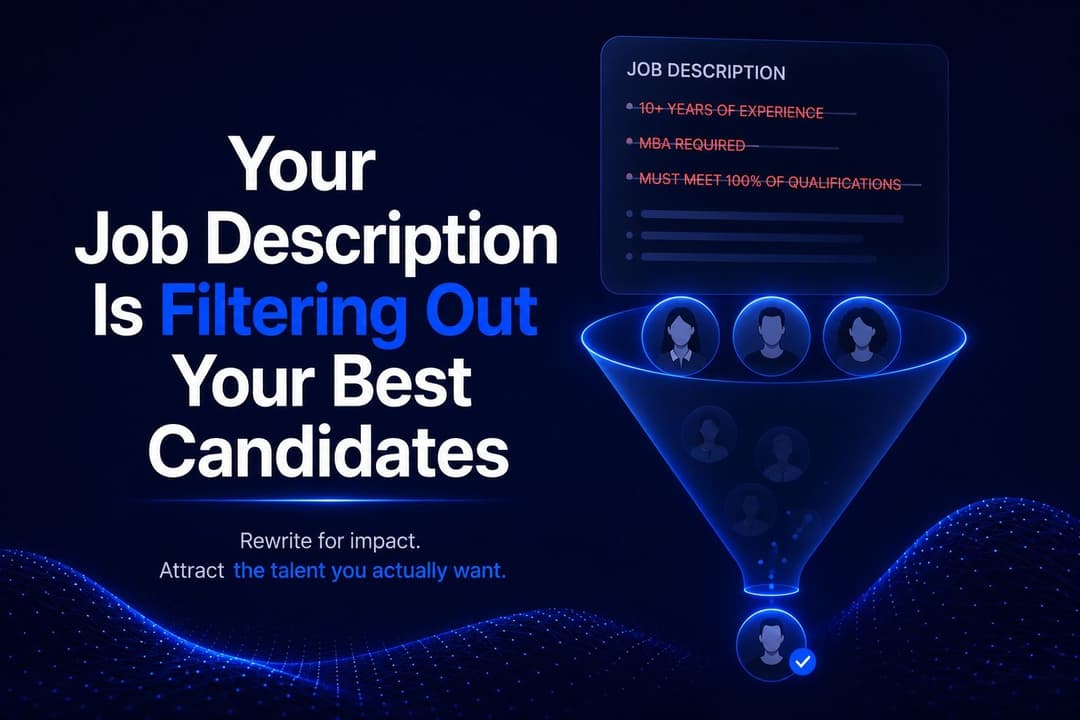
Bad job descriptions cost companies good candidates every day. Not in a vague, theoretical way—in very concrete ways that show up in pipeline quality, application volume, and ultimately who you hire.
The frustrating part: most of the problems are avoidable.
🚫 The Most Common Job Description Mistakes
The Laundry List of Requirements
“5+ years of experience. Bachelor’s degree required. Proficiency in 12 specific tools. Familiarity with industry frameworks A, B, and C.”
Research has consistently shown that women, candidates from underrepresented backgrounds, and early-career candidates with strong potential self-select out of roles where they don’t meet every listed requirement. Men with the same profile are more likely to apply anyway.
The result: it’s filtering out diversity and potential before a human ever sees the resume.
Writing for the Last Person Who Had the Role
Job descriptions are often copied from the previous iteration, which was copied from the one before that. They end up describing a historical composite of who held the role rather than what the role actually needs.
Ask yourself: what does success in this role look like in 90 days? 12 months? Write to that—not to a credential checklist.
Jargon and Corporate Speak
“We are seeking a dynamic self-starter to join our team in a fast-paced environment where they will leverage cross-functional synergies to drive impactful outcomes.”
This communicates nothing, candidates tune it out. The candidates you most want—who have good options and limited patience for noise—move on immediately.
Burying the Compensation
Candidates will find out what the role pays. Either from your posting (if you list it), from Glassdoor (if you don’t), or when they get to the offer stage (and potentially walk away because it’s not what they expected).
Hiding compensation wastes everyone’s time and signals a culture of opacity, list the range.
✅ What Actually Works
Lead With Impact, Not Requirements
Start with what the person in this role will accomplish, not what they need to have done before. “You’ll own our enterprise sales pipeline and be responsible for closing $2M in new ARR in your first year” is more compelling—and more filtering—than “5+ years enterprise sales experience required.”
Be Specific About What Matters
There are usually 2-3 things that genuinely predict success in a given role. List those clearly and with context. Everything else is noise. Be ruthlessly honest with yourself about which “requirements” are actually required and which are comfortable habits from how you’ve hired in the past.
Write Like a Human
Your job description is your first touchpoint with a candidate, It’s your pitch. Write it the way you’d describe the opportunity to someone you wanted to recruit at a networking event—with genuine enthusiasm, specific context, and honesty.
Include Culture and Context
What does your team actually look like? How do decisions get made? What does day-to-day look like for this role? Candidates want to know if they’ll belong and if they’ll be set up to succeed. Give them enough to make an informed decision.
🤖 How AI Can Help (and Where It Can’t)
AI tools can help you audit job descriptions for bias signals, suggest more inclusive language, and ensure you’re covering the key elements. SCALIS’s platform helps you build role criteria that inform Bella’s sourcing—the better your role definition, the more precisely she can match.
But AI can’t tell you what you actually need from the role. That strategic thinking still requires a conversation between the hiring manager and the recruiter—one that most companies skip in the rush to get a posting live.
Slow down on the front end, It saves time everywhere else.
📊 The Downstream Impact
A strong job description improves everything downstream:
- Higher application quality (the right candidates recognize themselves in what you’ve written)
- Lower application volume of bad-fit candidates (the filtering works both ways)
- Better AI matching (clear role criteria = better signal for sourcing engines)
- Stronger offer conversion (candidates who understood the role have fewer surprises at offer stage)
It’s the cheapest leverage point in your entire recruiting process and it’s almost universally under-invested.
Want a recruiting process that works from the first touchpoint to the final offer?
👉 Book a SCALIS demo and let’s talk about building a pipeline that starts with the right foundation.